The Ultimate Guide to Fine Grinding: Sand Mills, Bead Mills, and Nano Tech
- seosearchedges
- Feb 4
- 4 min read

When you're running a business that produces paint, ink, pesticides, or high-quality cosmetics, you know how important it is for your products to have the right texture (feel). As a general rule, the difference between an excellent product and a mediocre product is particle size, with larger particles causing problems with clogged sprayer guns, grainy-looking inks, and slow chemical reactions.
So how do you achieve this size? Well, you could rely on the heavy lifting done by wet grinding processes. However, the number of different names assigned to the same machine (horizontal sand mill, horizontal bead mills and nano bead mill) can make it hard to know what each type of mill is actually used for.
Here we will provide you with understandable explanations to help with the decision making process regarding which equipment best meets your production needs!
The Horizontal Sand Mill: An Old Favorite
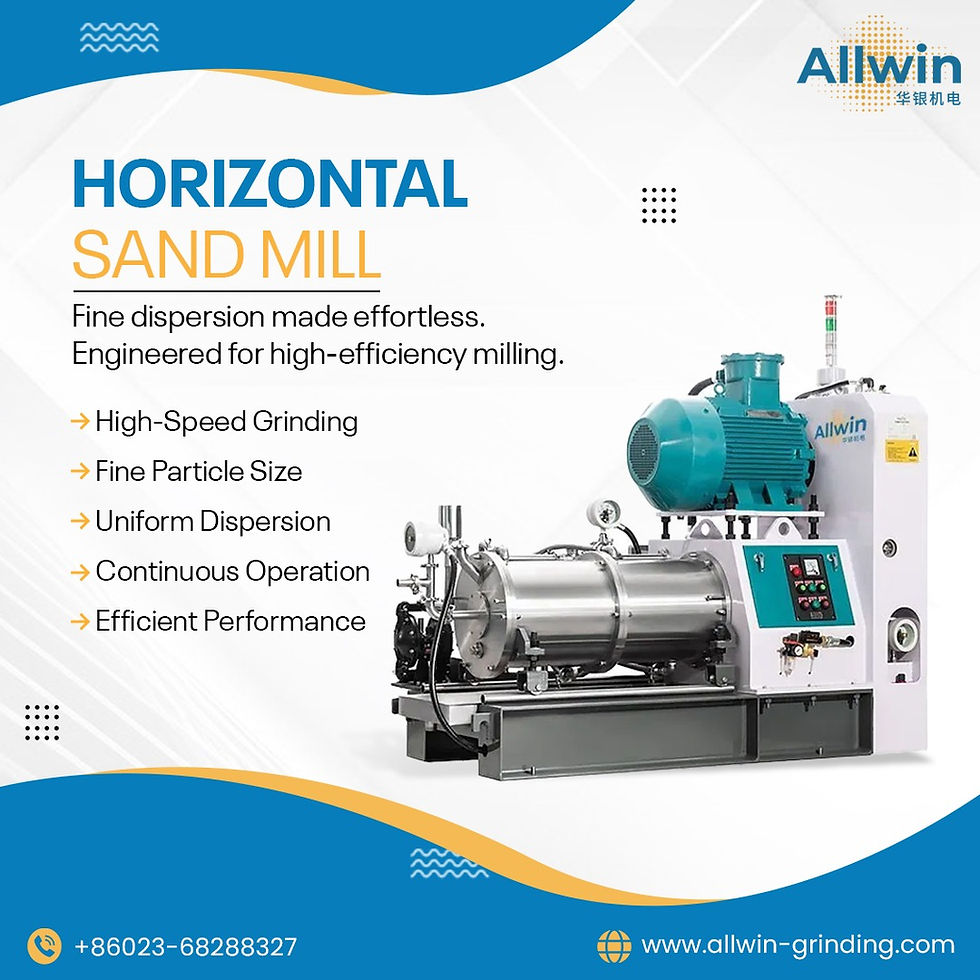
Let's start with the classic horizontal sand mill - the original method of wet grinding. In the past, these types of mills actually used sand (Ottawa sand) as the grinding medium.
The principle of operation has not changed substantially since the days of using sand for grinding. Picture yourself with a horizontally oriented cylinder filled with a liquid slurry (your product) and having a grinding medium (the sand). Running through the center of that cylinder is a shaft with discs or pins attached to it. As the shaft rotates at a high RPM, it agitates the sand, thus causing the sand to impact upon and break apart the product particles.
Today, we rarely use actual sand as a grinding medium for horizontal sand mills because it does not last very long and, furthermore, can contaminate the finished product. Instead of using sand, we typically utilize either glass beads or ceramic beads. Horizontal sand mill are most suitable for "medium-range" grind applications. If you manufacture industrial coatings, coatings for agricultural use, etc., and require a good, smooth-surface finish, but not necessarily a microscopic degree of precision, this is your type of mill.
The Evolution: The Horizontal Bead Mill
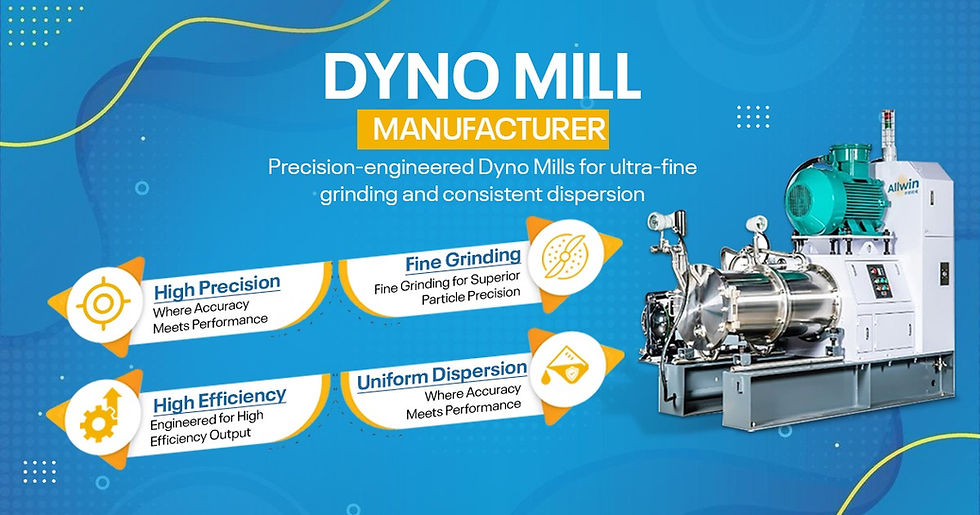
With that being said, we now have a new form of the Horizontal Bead Mill. One may ask, "Are a sand mill and a bead mill different?" They are quite similar in construction. However, when talking about horizontal bead mills, professionals are usually talking about modern, efficient machines designed for the use of engineered grinding media, or Zirconium Oxide beads.
The "horizontal" is very important here since vertical mills (which were previously used) had to work against the force of gravity to disperse the beads. In a horizontal orientation, the beads are distributed much more evenly throughout the chamber, ensuring that each gallon of material you put through is ground with equal intensity.

Horizontal Bead Mills are now the industry standard for producing high-quality paints and dyestuffs. They have better cooling systems (grinding generates a great deal of heat), improved seals for preventing leaks, and are capable of processing higher viscosity products that would cause older machines to become choked.
The High-Tech Tier: The Nano Bead Mill
Now, if you're producing ink for an inkjet printer and your ink must go through a microscopic nozzle or if you're creating a pharmaceutical drug that must be absorbed by the body as fast as possible, what do you do when "small" isn't small enough?
Then you need a Nano bead mill.
A regular bead mill may grind down to the micron level, but a nano bead mill can reduce the size of particles into the nanometer range (i.e., 1 billionth of a meter).
Although they operate on the same principles as other types of bead mills, nano bead mills are designed to achieve much greater precision through greater control. They operate using very small grinding beads, some as small as 0.1 mm in diameter. Due to their size, they will require a special embossed separator system to ensure that the grinding media do not leak into the product after it has been processed and collected.
What are You Looking for?
Selecting the Proper Mill for Your Application Determined by Your Overall Objective.
If you are going to Manufacture Paints, Coatings or Agrochemicals on a Large Scale then you Should Choose a Horizontal Sand Mill (also Known as Bead Mills). They are a Good Tool for Achieving A Standard Finishing Size.
If you are Going to Produce High Quality Products Quickly and Easily without any Additional Cleanup Time and You Would like to Incorporate Ceramic Beads as a Means of Improving Your Overall Outcome then Consider Using an Horizontal Bead Mill.
If You Are Associated with the Technology, Pharmaceutical or Advanced Material Industries and Will Be Producing Product-Sub Micron or Nanometer in Size Using a Nano Bead Mill Will Be Best for This Application.
Your First Step to Optimizing Your Production Should be Understanding the Terminology. All Mills are Functional For Whatever End Product You are Creating, but There Are Specific Types of Mills For Different Applications Such as Crushing Pigment or Creating the Next Generation of Battery Technology.
You will find these types of mills in the high-tech industry. If you are producing battery materials for electric vehicles, manufacturing ceramic semiconductors, or printing digital inks, the Nano bead mill will be the only machine that can provide you with the precision needed to perform these tasks successfully.

Comments