Mastering the Art of Wet Grinding: Why Your Choice of Wet Grinding Equipment Matters
- seosearchedges
- Apr 13
- 3 min read

If you’ve ever wondered about the reasons behind the smoothness of the paint on your walls or the silkiness of your favourite skin cream, you’ll want to know that they’re both made using a technology called wet grinding. Instead of the dry grinding method that is both messy and produces a wide range of outcomes, the wet grinding method suspends material particles within a liquid medium while they’re being milled. It’s becoming the technology most commonly used by manufacturers in North America to produce products with a “sub-micron” level of fineness.
Why is Wet Grinding the New Hot Trend?
There are a few reasons why wet grinding has gained so much popularity lately, though the primary one is the superior way wet grinding manages heat. As materials are reduced to smaller and smaller sizes, friction and heat build up between the particles. This heat generated by dry grinding can damage or destroy the product. Wet grinding uses the liquid medium as a coolant preventing damage to the product while simultaneously producing a finished product that is of the highest quality.
To take advantage of the benefits of wet grinding, many companies are now investing in state-of-the-art wet grinding machines. High-tech ceramics used in electronics and ‘plant-based’ milk alternatives are just a couple of examples of how wet grinding technology will continue to advance and improve product quality.
The Anatomy of a Modern Wet Grinding System
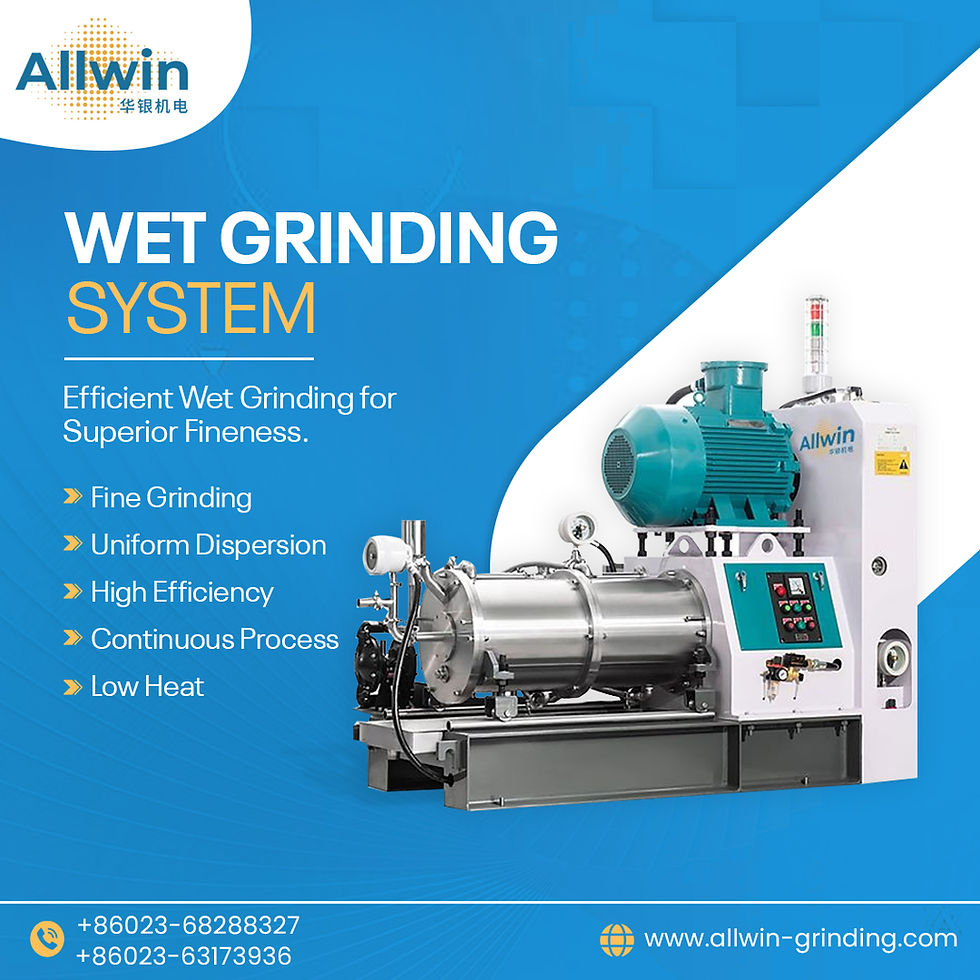
A full system for wet grinding is much more than simply a mill; it is a complex circuit consisting of a pumping system(s) for delivery of materials to the mill, the grinding chamber, cooling equipment, and a system for filtration of the ground material. A premium quality wet-grinding system will deliver slurry (the combination of liquid and solid) at a consistent temperature and consistent flow rate.
The majority of manufacturers of wet grinding equipment appear to have a focus on "closed-loop" systems. Closed loop systems are constructed to provide barrier(s) to outside air contamination; a requirement for pharmaceutical and food processing companies in the U.S. In addition to providing a means of preventing outside air from entering a wet grinding system, closed loop systems will result in reduced loss (evaporation) of any volatile liquids during the wet-grinding process; thus make the overall wet-grinding process more profitable as well as environmentally sustainable.
Key Components of Wet Grinding Equipment
The grinding media generally consists of small beads. The internal movement of the beads generated by the rotor produces both impact and shear forces that are required for particle size reduction.
US engineers recently conducted searches and discovered that there is great interest in low maintenance and easily disassembled wet grinding systems. This also includes easy cleaning of the machines, specifically when switching products frequently. Modern systems have automated controls enabling the operator to adjust speed and pressure by simply touching a button.
A High-Performance Wet Grinding System is beneficial for various reasons.
High-Performance Wet Grinding Systems will produce superior particle fineness than dry grinding:
A High-Performance Wet Grinding System produces a dust-free work environment: All of the materials that are used in wet grinding are liquid based, therefore, none of them will create hazardous dust in your workplace; thus, increasing employee safety.
A High-Performance Wet Grinding System creates a much more consistent particle-size distribution "bell curves" than do dry grinding systems.
A High-Performance Wet Grinding System is scalable: They have several different sizes and types of wet grinding equipment that can be built to produce small laboratory size batches to large industrial output sizes.
In summary, if you wish to produce products of good quality, high consistency, and safe products, it is essential to understand how to effectively produce high-quality products through the use of wet grinding systems. By investing in the correct equipment for wet grinding and developing appropriate system design for wet grinding systems, your company will be positioned for technical success for years to come, especially in today's increasingly competitive marketplace.

Comments