A Simple Guide to Horizontal and Laboratory Bead Mills
- seosearchedges
- Feb 24
- 3 min read

Have you ever wondered what makes your wall paint smooth or how the ink in your pen flows smoothly without clogging? If you are unfamiliar with the world of manufacturing and chemical processing, or are simply curious about how things are made, this guide will give you the fundamentals of bead mills based on their common horizontal configuration as well as some of the important laboratory models.
What is a Bead Miller?
A bead mill is an apparatus that grinds solids (such as pigments and chemicals) and distributes the resulting sludge through liquid combinations (i.e., paints). The apparatus's chamber contains millions of tiny beads made from mixed media, such as ceramic, glass, or steel (depending on the company making the beads).
When the machine is turned on and spun at fast speeds, the heat generated by the friction of the beads results in a number of drastic and high-speed reactions when liquid materials are pumped into the chamber.
As the liquids are pumped into the chamber, solids already within the liquid will become trapped by the reaction between the beads, and the noise produced by the impact is essentially the result of solid being mixed with bead material in the chamber to create a perfectly homogeneous and highly pulverized final product (not yet completely dried).
The Power of Horizontal Bead Mills
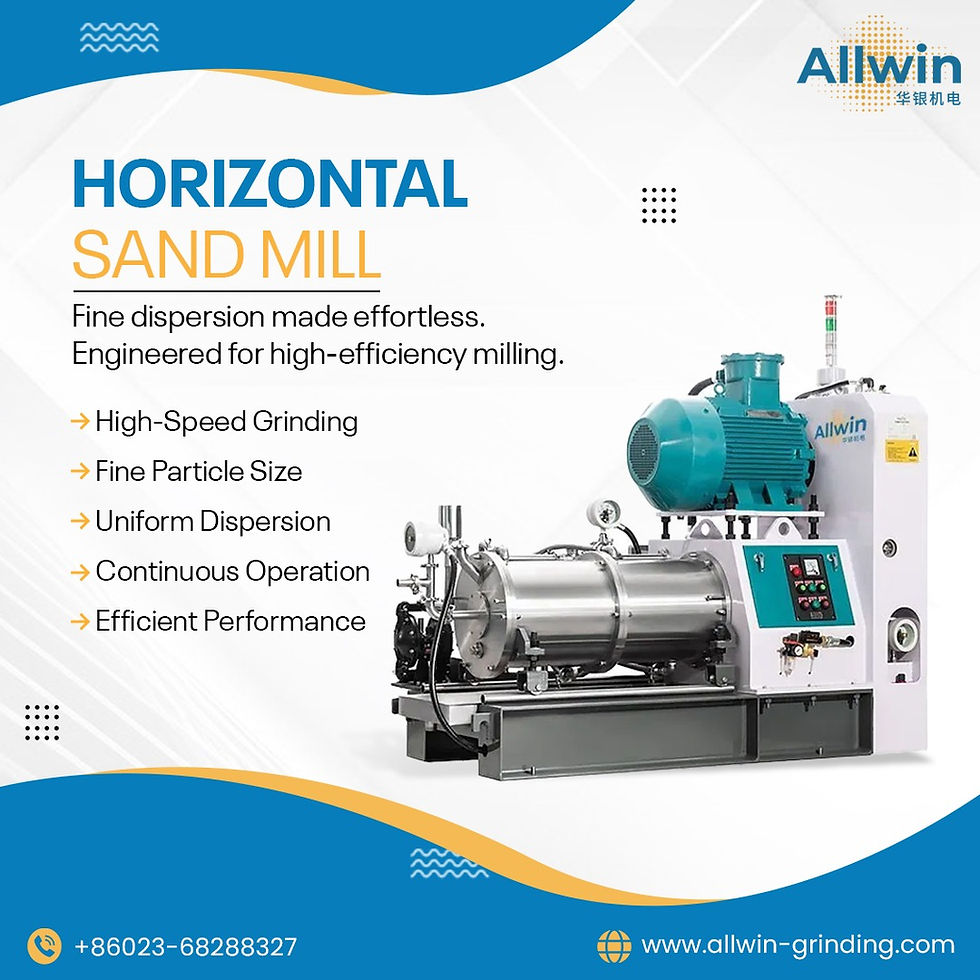
When it comes to types of mills, the Horizontal Bead Mill is the rock star of the industrial world. The Horizontal Bead Mill is a horizontal (sidewise) mill as opposed to a vertical (end-wise) mill which has its grinding chamber positioned vertically (up & down).
Why does the orientation of the chambers matter?
Superior Efficiency: On a vertical mill, gravity causes the beads to want to settle down on the bottom of the grinding chamber causing inconsistent grinding. With horizontal bead mills, gravity has no effect on the position of the beads in the grinding chamber. This allows for a consistent larger surface area to accomplish the same grind quicker than on vertical bead mills.
Pressure applied when grinding high viscosity liquids: Horizontal mills have a much better capability of handling pressure than do vertical mills when grinding thick/sticky (high-viscosity) materials than do vertical mills.
Continuous Production: These mills are designed to process continuously. In other words, you can keep feeding raw materials into one end of the mill while continually removing finished product out the opposite end without interrupting production. This capability to move huge amounts of finished product will prove essential for large manufacturing facilities producing several thousand gallons of paint and/or pesticides.
Laboratory Bead Mills – Testing New Product Recipes
Before putting tons of a product through a giant horizontal bead mill at the factory, the manufacturer will want to test their product recipe first, by answering some questions such as: How long will we grind? What size beads do we want to use? Is the formulation correct?
Laboratory bead mills are small versions of the large industrial bead mills. They are used in Research and Development (R&D) labs by scientists and technicians for a variety of reasons, including:
1. Cost savings – It’s expensive to run a large piece of equipment to test a new product idea, especially since the lab mill uses very small amounts of raw materials (e.g., just a few milliliters of materials).
2. Scale-up – A good laboratory mill is designed to work identical to the large bead mills. Therefore, if the product recipe works well in the small laboratory mill, the manufacturer can be confident that it will work well in the large Horizontal Bead Mills on the production floor.
3. Accuracy – The use of small, controlled conditions allows the scientist to control every variable, thus ensuring the perfect formulation before it goes to market.
Conclusion
Whether it is the bright dye in your clothes, the coating on a car, or the active ingredients in liquid medicine, grinding technology plays a massive role in our daily lives.
The Bead mill is the unsung hero behind these products. From the initial testing phase using Laboratory Bead Mills to the full-scale mass production using Horizontal Bead Mills, this technology ensures that the materials we use are smooth, stable, and high quality. Understanding these machines helps us appreciate the science that goes into the everyday items we often take for granted.
Read more: click


Comments